First Car Loan with No Credit History: What Young Australians Need to Know in 2026

By Brent Geihlick - Director at GO2 Finance — Queensland‑based finance brokers for first car buyers
Last Updated: April 11, 2026

By Brent Geihlick - Director at GO2 Finance — Queensland‑based finance brokers for first car buyers

Quick actions:
Get Pre‑Approved · Request a Fast Quote · Repayment Calculator
Getting your first car is a huge milestone – freedom, independence and no more begging for lifts. But if you’re a young Australian with no credit history, the idea of applying for your first car loan with no credit history can feel pretty daunting.
In 2025, lenders are closely watching how people borrow and ASIC is paying particular attention to car finance, especially for vulnerable and first-time borrowers. That doesn’t mean you can’t get approved – it just means you need to be smart about how you go about it.
At GO2 Finance, a specialist car and asset finance brokerage led by director Brent, we help young Australians right across the country navigate their first car loan. We work with a panel of lenders who understand that no credit history doesn’t automatically mean “high risk”, and we help you put your best foot forward without trashing your credit score in the process.
If you’d like expert help comparing lenders, repayments and loan structures as you read through this guide, you can reach out to GO2 Finance at any time for a friendly chat.
In this guide, you’ll learn:
This guide is designed for you if:
It’s also useful for parents or carers who might be helping – either by contributing to the deposit or acting as a guarantor – and want to understand the risks and options.
When a lender checks your credit file, they’re looking for a track record: have you borrowed before, and did you pay it back on time?
If you’ve never used credit, or you’ve only had something small like a phone plan, your file is what’s known as “thin” or “nil” – there’s not much data for a lender to work with.
That doesn’t automatically disqualify you from a car loan. It just means the lender will lean more heavily on other factors, like your income, employment and bank statements.
It’s really important to understand the difference between:
Most lenders see no credit as less risky than bad credit. You’re more of an unknown than a proven problem. That’s why there are lenders – and brokers who work closely with them – who are prepared to consider first-time car buyers with limited or no credit history, especially when everything else in the application is solid.
A thin or blank credit file can still be okay if you:
In other words, a lender may think: “We don’t know a lot yet, but the signs we do see are positive.”
For most young Australians, a first car loan is a secured personal loan – the car is used as security for the loan. If you don’t meet repayments, the lender may ultimately have the right to repossess and sell the car to recover what’s owed.
Most personal car loans for individuals are regulated under the National Consumer Credit Protection Act 2009 (NCCP Act) and the National Credit Code. Under these laws, lenders and brokers must make reasonable inquiries about your situation and must not suggest or assist with a loan that would be unsuitable for you.
You can typically finance:
You’ll repay the loan over an agreed term (often 3–7 years) with fixed or variable repayments. Interest rates and fees vary between lenders and will depend on your circumstances and the car you’re buying.
Secured car loan
Unsecured personal loan
For most first-time buyers with no credit history, lenders are more comfortable with secured car loans, because they have an asset backing the loan.
Different lenders have different rules around:
A broker like GO2 Finance can help you pick lenders that match the kind of car you’re buying so you’re not wasting applications on lenders that won’t accept it.
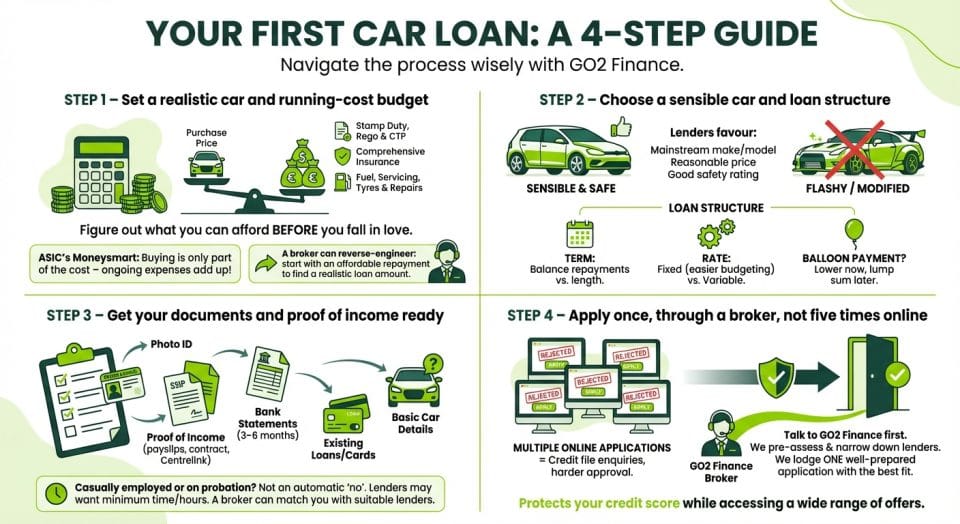
Here’s a practical, 2025-ready game plan for getting your first car loan approved – without nasty surprises down the track.
Before you fall in love with a car on Marketplace, figure out what you can comfortably afford, including:
ASIC’s Moneysmart resources emphasise that buying the car is only part of the cost – ongoing running expenses add up quickly and should be built into your budget.
A broker can help you reverse-engineer this: start with a repayment you can afford, then work back to a realistic loan amount and car price.
For a first car loan with no credit history, choosing something sensible and safe usually works better than going for a flashy performance car. Lenders tend to look more favourably on:
Loan-wise, think about:
Typical documents lenders may ask for include:
If you’re casually employed or on probation, that doesn’t automatically mean “no”, but some lenders will want to see a minimum time in the role or consistent hours. A broker can help match you with lenders who are more comfortable with your employment type.
Every full car loan application can leave an enquiry on your credit file. Too many in a short time can worry lenders and make approval harder.
Instead of firing off multiple online applications:
This protects your credit score while still giving you access to a wide range of lenders and offers.
When your credit history is thin, lenders lean heavily on other parts of your application.
Lenders generally consider:
Younger borrowers, especially under 25, are often seen as higher risk because they have less work history and less financial track record. That’s why showing stability, even if it’s only been a few months is valuable.
With no credit history to look at, many lenders scrutinise your bank statements. They’ll look for:
Showing responsible money habits – paying bills on time, not constantly going into the red – can help offset a lack of credit history.
A contribution from you (savings or a trade-in) lowers the lender’s risk. Even a small deposit can:
The car itself also matters: lenders are usually more comfortable with a reliable, mainstream car than a high-powered import or heavily modified vehicle.
You don’t always have to have a deposit for a first car loan, but saving even 5–10% of the purchase price can make a big difference. It shows discipline and lowers the amount you need to borrow.
Try to also keep a small buffer in your account so your first few repayments don’t wipe you out.
Some young buyers involve a parent or family member as a:
This can help in some scenarios, but it’s a serious commitment for the other person. If things go wrong, it can affect their credit history and relationship with you. Everyone should understand the risks and, ideally, get independent advice before signing.
At GO2 Finance, we can walk both of you through the pros and cons so nobody feels pressured.
You don’t need to go out and grab a bunch of loans just to “build credit”. But sensible use of small products – like a phone plan in your own name or a low-limit card you pay off in full each month – can help establish a positive track record over time, if you use them carefully.
If you’re not confident you’ll manage it well, it can be safer to focus on building savings and keeping your bank statements clean instead.
Car dealers often sell finance as part of the process. Sometimes the rate is competitive; other times it’s offset by:
“0% interest” or “no repayments for 12 months” deals can be complex and may cost more overall once fees or inflated car prices are factored in. Consumer sites and Moneysmart regularly warn buyers to look beyond the headline offer and compare total cost.
With rents, fuel and groceries all rising, it can be tempting to stretch yourself to get the car you really want. The risk is that even one life change – fewer shifts, moving out, starting uni – can turn a manageable repayment into a problem.
A good rule of thumb: your car repayment should still feel comfortable after you add realistic running costs and a bit of breathing room.
Always watch for:
A broker can help you understand the true cost of each option before you sign.
At GO2 Finance, we know how easy it is for young borrowers to accidentally damage their credit score by applying with too many lenders at once. We help you avoid that by:
This strategy lets you compare options without scattering enquiries all over your credit report.
Different lenders have different appetites when it comes to:
Because we work with these lenders every day, we know who is more comfortable with your type of situation. That means:
If you’re unsure where you stand, you can talk to Brent and the team about your scenario – no pressure, just straight answers.
When you’re new to credit, having the right people in your corner matters. Here’s why many first-time buyers choose GO2 Finance:
If you’re thinking about your first car loan with no credit history, a quick conversation with GO2 Finance can save you a lot of guesswork.
Before you hit “apply”, run through this quick checklist:
If you can tick most of these boxes, you’re in a good position to talk to GO2 Finance about the next steps. A quick online enquiry or short phone call can get the ball rolling on your first car loan.
Yes. Lenders assess income, stability, and deposit. A broker can match you with policies suited to thin credit files.
GO2’s eligibility checks can be done with no credit hit. A formal application may involve a credit check.
A lump sum due at the end of the loan. It lowers monthly repayments but you’ll need to pay, sell, or refinance later.
No. Add-on insurance and extended warranties are optional. Know your rights and compare value before buying.


We offer real advice, real people, and full transparency. No surprises, no credit hits. That’s how we’ve helped 500+ Aussies (and counting).
Brent Geihlick, Director at GO2 Finance
Brent Geihlick is the Director of GO2 Finance, a trusted Australian brokerage specialising in car, caravan, boat and equipment loans. With extensive experience across asset finance, lending strategy and credit assessment, Brent has helped thousands of Australians secure affordable loans through clear, honest and personalised guidance.
Brent works directly with clients and over 50 lending partners, giving him deep insight into how credit scoring, loan approvals and lender policies operate behind the scenes. His approach is simple: make finance transparent, protect clients from unnecessary credit damage, and match every borrower with the right lender for their goals.
Every article Brent publishes is based on real industry experience, current lending guidelines and practical day to day knowledge from working inside Australia’s finance landscape.
General advice only: This guide provides general information and doesn’t take into account your objectives, financial situation or needs. Consider whether it’s appropriate for you and read the lender’s T&Cs and comparison rate examples. Seek independent tax advice for chattel mortgages or any business use.
At Go2 Finance, we like to help, providing you with updated information, news, and tips to ensure you find the best financing.